Tuesday, February 17, 2015


.JPG)


.JPG)
.JPG)
.JPG)

Thursday, February 12, 2015
Linguistics
We found this statement in a book we are reading on island nations in the Pacific:
A quick internet search turned up this and this from Nat Geo, both of which claim that the Pacific contains 19% of the world's languages, which is still impressive considering that the population of Oceania is less than 1% of the global population.
Does anyone have any more information about this? Comments or thoughts?
"These small scattered island groups are, however, amazingly diverse in terms of native culture. One-third of the world's languages are spoken in just four places: Papua New Guinea, the Solomon islands, Vanuatu and New Caledonia." (Pacific Ocean, World Almanac Library. Jen Green 2006)Really? That sounded very hard to believe. So we looked it up.
A quick internet search turned up this and this from Nat Geo, both of which claim that the Pacific contains 19% of the world's languages, which is still impressive considering that the population of Oceania is less than 1% of the global population.
Does anyone have any more information about this? Comments or thoughts?
Tuesday, February 10, 2015

Sunday, February 8, 2015
Sea turtles

 |
| A. held this one, then released it back into the water. They can reach up to 35mph speeds |


 |
| They take "mug shots" of the turtles, and photos of their shells since each pattern is kind of what a thumbprint is for humans: individual and unique |

They invited me to serve as a volunteer sometime. Along with other duties, I will evidently get to swim along in the water with Jesse and watch underwater while he does his thing. Yes, please!
Friday, January 30, 2015
we flew to Tinian
You can see the island of Tinian from Saipan. It doesn't even need to be a particularly clear day; it's just three miles away, to the south. We went there for a week recently, tagging along while Daddy worked at the hospital temporarily.
It is about a 7 minute flight, since Saipan's airport is on the southern end of the island already.


 |
| That plane there on the right was ours |
Maybe we were a little nervous...
 |
| (coast of Saipan) |
 |
| (coast of Tinian) |
We do not get tired of visiting new places with stunning ocean vistas.
Tuesday, January 27, 2015


Monday, January 26, 2015


Latte Stones, part II, on Tinian (by AM)
We walked to the Taga House from our hotel (in the rain!), and saw the gigantic latte stones there. In the Marianas, Tinian is famous for this site because it is one of the only places where ruins of latte stones are easily found, and they are the largest. The latte stones there are the actual ones left over from the Taga House that chief Taga is believed to have constructed.
I am surprised that they have not all crumbled away! Only one latte stone is still standing. The others toppled over because of earthquakes, wear and tear, or perhaps battles.
The latte stones are made from coral rock, taken from the quarry at Taga Beach, where the ancient Chamorros dug into it. No one really knows what they dug into the coral with, or how they carved the stones. The latte stones at the Taga house are between 15 and 17 feet high.


 |
| top view of capstone |


On the sign at the entrance of the Taga House site, they posted the legend of the Man of Taga and how he became the chief of the ancient Chamorro village. He was believed to have been a giant, and tremendously strong.
FACTS:
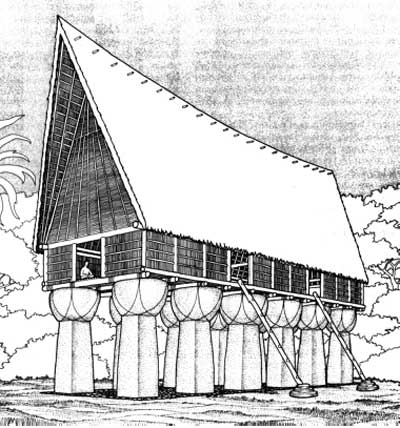
- The latte capstones were constructed in such a way where they curved; one of the theories of why this is so, is because it prevented rats from climbing into the buildings.
- There is a quarry at Taga Beach, as I have already mentioned, across the street from the Tinian Dynasty Hotel and Casino. Some people believe that the ancient Chamorros floated the cut-out latte stones on rafts over to the Kammer Beach area, 1 mile away and carved them there. Other people believe that they carried the stones on their shoulders and necks back to their houses.

There are a lot of unanswered questions about the latte stones and the buildings they made with them. We don't even know for sure what the houses looked like, although some folks have made some guesses. What we do know is that they are unique to the Mariana Islands and were an impressive accomplishment in their day.

Subscribe to:
Posts (Atom)